Showing posts with label ukiyoe. Show all posts

Monday, October 8, 2018

CAT AND MOUSE (c.1870, by Kyosai Kawanabe)


CAT AND MOUSE (c.1870, by Kyosai Kawanabe)


     A humorous print by showing a cat holding aloft a rat by it’s tail with a sliver of moon just above them. Printed only in sumi and light brown. This print is considered quite rare and was published by Wawamuraya Seikichi in Tokyo.

     Kyosai Kawanabe (1831 - 1889), an extremely skillful artist who worked as a painter, print maker and illustrator, was born as the son of a samurai, and as a child, joined the school of Kuniyoshi Utagawa. During his career he was most noted for his prints with humorous and caricature-like subjects, although I have seen some very sensitive and skillful landscapes of his that I enjoyed very much. He is nicknamed the "comic genius"; some of his humor perhaps stemming from his strong liking for saké. He was also one of Japan’s first political caricaturists. His ability to perfectly portray attitudes through the posture and movements of the figures in his prints gained him a reputation for being one of the most individualistic artists of the Meiji period.


© 2018 by Hayato Tokugawa and the Kitty Mafia Art Worx™. All rights reserved.

Saturday, November 15, 2014

SHIN YOSHIWARA — OIRAN DOCHU

SHIN YOSHIWARA — OIRAN DOCHU
FROM THE SERIES TOKYO MEISHO
(FAMOUS PLACES OF TOKYO)


The name of the artist of this print is unknown; however we know that it was done in 1925 as a lithograph rather than printed by the more common means of printing a typical ukiyo-e. In the print, one sees courtesans of the pleasure quarter, Shin Yoshiwara, parading with their assistants on Nakamachi Street. Typically in earlier times, such a procession was the main event of the day in Shin Yoshiwara and was referred to as “Oiran Dochu.” The custom had in fact been discontinued with the advent of Meiji but was revived on the occasion of the Taisho Expo in 1915. Here the women had the opportunity to show off their beauty and gorgeous clothes.


Saturday, July 5, 2014

ICHIKAWA DANJURO - FUDO (c. 1950). by Masamitsu Ota (1892-1975)


Ichikawa Danjuro - Fudo (c. 1950) 
By Masamitsu Ota (1892-1975)

Kabuki actor Ichikawa Danjuro X or XI is in the role of Fudo. This print is from the series, '' Kabuki Juhachi-Ban '' (The Eighteen Famous Kabuki Plays by the Ichikawa Family).

Ota Masamitsu, 1892-1975, is one of the lesser known artists of the Japanese shin hanga art movement who designed woodblock prints of kabuki actors and costumes. Be that as it may, it does not mean that his prints are in any way inferior to those of Natori Shunsen or others. He is also known by the name of Ota Gako, and was active in the kabuki theater, and produced illustrations for books on kabuki.


Ota actually began as a print artist after World War II, and is well-known for two series of twelve prints each, that were published by Banchoro studio. The first series was published around 1950 and was titled "Showa Butai Sugata" (Figures of Showa Stage). The second series was published around 1955 and was titled "Gendai Butai Geika" (Figures of Modern Stage). The carver was Ito Susumu and the printer Ito Shuntaro. Both series are brilliant in their detailed depictions, the fine gradations to achieve a three-dimensional impression, the realistic rendering of texture like the actors' clothes, and the individual characterizations of the artists. Technically superb, these Japanese woodblock prints are recommended for collectors of Japanese prints and for fans of the Japanese kabuki theater, although rather rare in the market. They are not quite cheap; but depending on where they are purchased and from whom, still very affordable.

Tuesday, June 17, 2014

SNOWY NIGHT LEGNED: By Yumeji Takehisa (1884 – 1934) Date c. 1910 – 1930.


Snowy Night Legend by Yumeji Takehisa (1884 – 1934) Date c. 1910 – 1930.

Yumeji Takehisa has been considered as the main figure who propelled “Taisho romanticism.”. The dreamy, fragile looking girls Yumeji invented in his works were so popular during the period of 1900 -1930 that they became the cultural icon of the Taisho /early Showa eras. Many artists imitated this "Yumeji-look" in order to take advantage of Yumeji’s popularity. Even today, he has been one of the most beloved artists in Japan. In addition to his work as an artist, he was also a writer and a poet.

He was born in a small village where his father Kikuzo worked as a sake brewer and today the family's home stands as a museum open to the public. As a child he was a passionate drawer. While attending a high school in Kobe, which was affiliated to the University of Waseda, he discovered his fascination for different and exotic things. At that time he started writing short stories and poems as well as creating illustrations for a magazine. When his parents decided to move to the south of Kyushu Island, Yumeji Takehisa wanted to go to Tokyo; however, his parents instead sent him to the private university of Waseda where he made a lot of friends. Shusui Kotoku (1871 - 1911), a famous socialist and anarchist, was one of them. At the age of 19 Yumeji Takehisa began to be engaged in portraiture.

At the age of 23 Yumeji Takehisa married Tamaki Kishi who, much to his advantage, ran an art store; however after only two years they were divorced. Tamaki was his major model and the reason why he turned to bijin-ga, a type of Japanese art which is about beautiful women. Traditionally most Japanese woodblock artists make bijin-ga - images of beautiful women - sooner or later during their career. Many women of whom Yumeji Takehisa fell in love posed for him and became his lovers.
In 1916 Yumeji Takehisa became chief illustrator of Shin-Shojo (Fashionable Girl) and of Fujin no tomo (Women's Friend) magazines. Later on he restarted making illustrations for the Kodomo no kuni (Children Land) magazine.
In 1923 his further career was brought to a halt by the great Kanto earthquake. Most of his woodblocks were destroyed Yumeji Takehisa had to restart from the beginning. He worked very hard and at last in 1931 he was able to make a journey to the U.S., Germany and Italy in order to show his work. But it was his last trip. In 1933 he returned to Japan because of a serious disease. Yumeji Takehisa died in the sanitorium of Fujimi Hiland in 1934 and was buried in Tokyo.

Being active in the hanga (Japanese for "print") movement, Yumeiji Takehisa was influenced by modern Western art, out of which a new style developed: "Taisho romanticism". Takehisa became one of its major exponents - mainly in the field of color woodblocks. He filled the decorative element of this style with a melancholic, poetic atmosphere which formed a beautiful harmony with the charm of beautiful women.

The minimalistic, sometimes naive compositions made Yumeji Takehisa one of the most popular artists in Japan of his time. After his journeys to the United States of America and to Europe the Western influence became more dominant in his style, with the traditional style of the Japanese woodblock being more and more replaced by expressionism, abstraction and simplification.

Tuesday, June 3, 2014

KESHO NO ONNA (WOMAN APPLYING MAKE-UP) C. 1918. By Hashiguchi Goya

Hashiguchi Goyō (橋口 五葉 Hashiguchi Goyō, December 21, 1880 - February 24, 1921) created only 14 published prints during his life-time — the first at age thirty-five and the last shortly before his death at forty-one. These prints are among the finest and most expensive modern Japanese prints a collector can buy and made Goyo immortal. If Hashiguchi had not been of such frail health, he could have become the leading Japanese artist of the twentieth century. 
Hashiguchi was born as the son of a samurai in Kagoshima as Hashiguchi Kiyoshi. He was taught in traditional Kano painting by his father, an amateur painter, from the early age of ten. Later he went to Tokyo, called himself Goyo and studied Western oil painting at the Tokyo School of Fine Arts, from which he graduated in 1905 as the best student of his class. 
His first commission was an illustration for a book titled I am a Cat by Natsume Sōseki in 1905. In 1907 Hashiguchi won the first prize in a contest for an ukiyo-e poster. This brought him some public recognition and one would have expected the artist to jump into creating more Hashiguchi prints but he was disappointed by an unenthusiastic public in future shows. In 1911 he again won recognition for an ukiyo-e poster designed for the Mitsukoshi department store. From that point on he became a serious student of ukiyo-e and began to study ukiyo-e from books, originals, and reproductions. He was especially interested in the great classical ukiyo-e artists. He was especially interested in the great classical ukiyo-e artists. From 1914, while frail and suffering from beriberi, he contributed articles on various ukiyo-e studies to Art News (Bijutsu-shinpō) and Ukiyo-e magazine, and wrote several articles about Utamaro, Hiroshige and Harunobu on a scholar-like level.
In 1915, urged by the shin-hanga publisher Watanabe Shōzaburō, he designed a print for artisans to produce under Watanabe’s direction. Goyō designed "Bathing" (Yuami), Watanabe wanted to continue the collaboration but Goyō had other plans. Instead, he worked in 1916-1917 as supervisor of reproductions for 12 volumes called "Japanese Color Prints" (Yamato nishiki-e) and in the process became thoroughly familiar with the functions of artisan carvers and printers. At the same time he was drawing from live models. From 1918 until his death he produced thirteen more prints - four landscapes, one nature print depicting ducks and eight prints of women. His total production, including "Bathing," numbers fourteen prints. (After his death a few more of his designs were developed into prints by his heirs.)
The first Goyo Hashiguchi print titled Woman in bath or Yuami was a terrific masterwork. Watanabe was enthusiastic and wanted to continue the cooperation with Hashiguchi. But the artist had other plans. Probably he was feeling too much restricted in his artistic freedom by the successful but rigid and business-like Watanabe. 
In late 1920, Hashiguchi's latent health problems escalated into meningitis. He supervised his last print Hot Spring Hotel from his death bed in hospital, but could not finish it personally. He died in February 1921. 
Goyo had left several sketches from which his heirs — his elder brother and his nephew — had later produced seven more prints. The carving and printing had been commissioned to Maeda Kentaro and Hirai Koichi. 

Goyo Hashiguchi prints are of extremely high quality standards. They were sold at very high prices at the time of their first publication and sold well nevertheless. The tragedy of Hashiguchi was the short time span of only two years to produce these superb masterworks - apart from his first print published with Watanabe.

Sunday, May 11, 2014

ONE HUNDRED FACES - GOSSIP, STUTTERER: By Kobayashi Kiyochika


One Hundred Faces - Gossip, Stutterer

Kobayashi Kiyochika made the compilation of humorous gestures and faces titled “Shinban Sanju-ni So” (New Thirty-two Faces). Because of the popularity of the series, he made additional designs and combined them into one series, “Tsuika Hyaku Men So” (Addition; One Hundred Faces).
From left top to right bottom: “Mimi Komori” (whisper, gossip). “Domori” (Stutterer). “Tohmi” (Looking far away, Oh so beautiful...). “Karashi ga kiita” (Very effective mustard. Wow, so spicy!).

Kobayashi Kiyochika (小林 清親 September 10, 1847- November 28, 1915) was a Japanese ukiyo-e painter and printmaker of the Meiji period,born at a time when the old order of the Shogunate was already on shaky grounds and an adolescent when Western civilization rolled over Japan. For him, life became like a small boat in a rough sea
He was born into a family of lower-ranked samurai that served the Tokugawa family — something which a hundred years earlier or even fifty years earlier would have been a very pleasant thing; but in Japan, times were changing.
In 1853 a U.S. Naval fleet of black iron ships — unknown before in Japan — anchored off the Japanese coast near Uraga. One year later in 1854, Japan was forced to open its borders for commercial relations with the United States in the Treaty of Kanagawa. This was the end of the old order. From then on, things changed too rapidly for a country that had sealed off its borders for 250 years.
Soon skirmishes broke out between the Loyalists — supporters of the old (Edo Period) order, mainly the samurai class who saw their century-old privileges going down the drain — and the promoters of the new order. The enemies of the Shogun rallied around the Emperor, who had resided in Kyoto since 1192 as a purely ceremonial figurehead — a toothless tiger.
But now, the tiger began to wake up and to show his teeth after nearly 700 years of subjugation by the Shogunate, which had exercised the real power in the country. Several fierce battles were fought between the two camps. The most bloody and the decisive one was the Battle of Ueno in which 2000 men of the Shogunate troops were badly defeated. The last Shogun Tokugawa Yoshinobu resigned in 1868.
Kobayashi Kiyochika had been fighting on the side of the Shogunate. He survived that time, the Bakumatsu, unharmed; but with the establishment of the new Meiji era under the rule of the Emperor Meiji, he found himself, in effect, a ronin — a lordless samurai. In the beginning he tried to survive by doing odd jobs. Later, in 1875, he tried his luck as a self-taught painter.
During that time, he happened to meet  Charles Wirgman, an English painter, cartoonist and correspondant for a British newspaper in Yokohama. Kobayashi studied art with him for a short period. Also at that time, he met Shimooka Renjo, a photographer, from whom he learned the principles of photography.
The following year, 1876, Kobayashi Kiyochika created his first woodblock prints — scenes from Tokyo. Although his prints were basically kept in traditional Japanese style, Kiyochika used Western elements like perspective, the effect of light and the graduations of shadows, having read about the French impressionists and seen photographs of their works in newspapers.
In the early 1880s, Kiyochika's style became a bit more traditional. He also turned to satirical cartoons and illustrations for newspapers and magazines. During the Sino-Japanese war he made about 80 war prints. War prints were like a last commercial resurgence of the old ukiyo-e business. Kobayashi's war prints are regarded as among the best in this genre, with a masterly play on the effects of light.
In 1894, Kiyochika established his own art school. One of his students was Tsuchiya Koitsu who stayed in his master's home for 19 years. Today Kobayashi is considered as the last master of the “old” ukiyo-e. But he was more than that. He was able to combine traditional ukiyo-e with modern Western style and thus showed a new direction for a subsequent generation of young artists like Hasui Kawase or Hiroshi Yoshida.
Despite his efforts, he could not stop the commercial decline of ukiyo-e, but he did pave the way for a new renaissance of the Japanese print - the Shin Hanga movement.


Wednesday, April 23, 2014

BEAUTY AND THE ROOSTER: By Takeuchi Keishu

Beauty and the Rooster by Takeuchi Keishu. C.1909.


The Japanese word "kuchi-e" translates literally as "mouth-picture" and, in a descriptive manner typical of many Japanese terms, refers to the multi-color woodblock prints that were inserted into the fronts (that is, the "mouth") of literary magazines and novels during the late Meiji era. (These illustrations were also frequently referred to as "sashi-e.") Due largely to the time during which they were produced, many of these story illustrations where produced to the highest of standards, exhibiting advanced printing techniques typical of "surimono" (privately commissioned woodblocks) such as the use of "gauffrage," extensive "bokashi" shading, "burnishing," the use of metallic pigments, and highly detailed carving.

Although a few books' kuchi-e were of a smaller size that did not require folding, typically these woodblock illustrations were produced as over-sized prints that were inserted into the fronts of these books as "fold-outs." As these novels and literary magazines were typically printed and bound in a tall, narrow format, in order for the single kuchi-e illustrations to fit within the closed book, they required two folds.

Some of the most popular so-called kuchi-e prints at the end of the 19th and beginning of the 20th centuries were designed by Takeuchi Keishu, a student of the famous, and by many seen as the greatest Meiji artist, Tsukioka Yoshitoshi. Kuchi-e were one of the few possibilities for printmakers in Japan to make a living at the time, but at best, it was usually a meager living, even for someone as popular as Takeuchi Keishu.

Thursday, October 10, 2013

SNOW AT YOKUMO BRIDGE


     SNOW AT YOKUMO BRIDGE (1930): by Hasui Kawase, from the series, "Nihon Fukei Shu II , Kansai hen" (Collection of Scenic Views of Japan - II, Kansai Edition). "Kobe, Nagata-jinja Yakumo-bashi". Yakumo Bridge at Nagata shrine in Kobe in a snowy day.


     Hasui Kawase is one of the best known artists of the "Shin Hanga" (new prints) movement. His prints, landscapes and townviews, were created in traditional Japanese style with Western elements. Hasui had a very close cooperation with the publisher Watanabe. In the fires following the devastating earthquake in 1923, over a hundred blocks produced so far, were destroyed. In 1956, one year before his death, the artist was declared a Living National Treasure.

     For a complete biography of Kawase, refer to A TASTE FOR UKIYO-E, A Snowy Night at Zojoji Temple.


Copyright 2013 by Hayato Tokugawa. All rights Reserved.

Wednesday, October 9, 2013

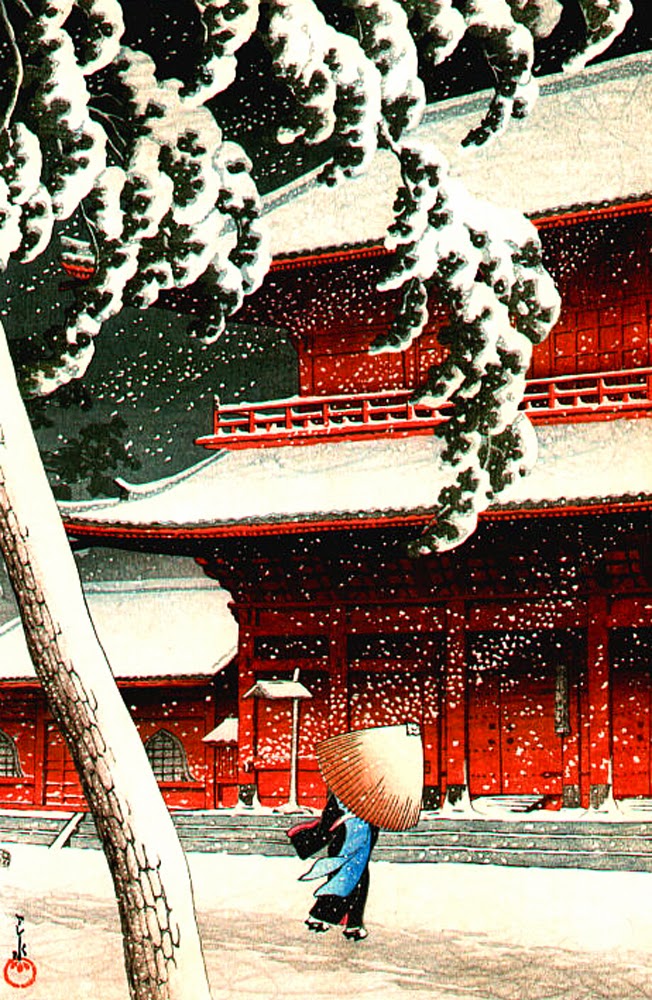
A SNOWY NIGHT AT ZOJOJI TEMPLE: By Kawase Hasui


  According to noted Japanese author and authority on the art of Japanese prints, Narazaki Muneshige, although he was not well known inside Japan, Kawase Hasui (1883 – 1957) was quite famous in the West, and one of the three greatest woodblock print artists of Japan, standing in the company of Hokusai and Hiroshige. A master of the Shin Hanga (新版画) or “new woodcut (block) prints”) movement of the early to mid-twentieth century, his work was declared to be a Living National Treasure.

     Hasui was born in Tokyo, the son of a well-to-do merchant family. Although later a source of conflict within the family, he was given the opportunity at an early age to study Western-style painting under famed watercolorist and print maker Saburosuke Okada (1869 – 1939) who instructed the boy in the arts of both watercolor and oil painting. As his enthusiasm for art grew, his family’s did not, eventually attempting to block his studies in any way possible. To their mind, he was destined to work at the family business. The problem was ultimately solved when one of his sisters married a shop employee and took over the family business in his stead.

     When he was twenty-six, Kawase asked to be accepted as a student of traditional Japanese-style painter Kiyokata Kaburagi (1878 – 1972), a master of the bijinga genre popular at the time. Kaburagi however regarded Kawase as being too old for an apprenticeship and rejected the young man. Undaunted however, a determined Kawase was back two years later and Kaburagi relented, recognizing the young man’s talents and ultimately introducing him to Watanabe Shozaburo (1885 – 1962), the famed print publisher and central force behind the shin-hanga movement, beginning what would ultimately be a long, close, relationship.
Watanabe was, in fact, the initiator, the “spiritual” and the driving commercial force behind shin-hanga. At a time when the popularity of traditional ukiyo-e printmaking was in rapid decline and approaching actual extinction, it was Watanabe who gathered together a small group of literally starving artists and gave them commissions for prints. At the time, ukiyo-e had been a mass-consumption product; one which stood little chance of survival in competition with the growing popularity of photography. Watanabe’s commissioned prints were however targeted to a more specific audience: lovers of Japanese art, outside of Japan.

     From 1918 through 1923, Kawase produced over a hundred prints, all published by Watanabe, and primarily exported to the United States. However, no good deed goes unpunished. On September 1, 1923 Japan was struck by one of the worst earthquakes ever to strike the country up until that time. Over 140,000 people died in the Great Kanto Earthquake and the resultant fires which raged through the Tokyō – Yokohama region. Watanabe’s print shop was destroyed by fire and with it went all of Kawase’s woodblocks. Adding insult to injury, Kawase’s home was destroyed and with it went all of his sketchbooks.
During his career, Kawase produced over four hundred woodblocks for Watanabe, many of which were elegant landscape prints, often showing night scenes, snow, and rain, demonstrating his ability to create distinct moods in his work. Often there are no people, choosing instead to leave the viewer with a feeling of peace and tranquility; however with an undertone that was frequently strange or even uncanny.

     Unlike many of his contemporaries, he did not work at home but rather chose to work in the field — on the spot — often travelling around the country with the intent of creating his prints from a “live” view. He would sketch in the field, then return to his inn where he would add color to the drafts. Later he would return to Tokyō where the carvers and printers would be given his work. But that is not to say that once the sketches were turned over for production that he divorced himself from the process. Rather, he was involved in the entire process from sketch, to cutting of the blocks (one block per color plus a “key” block for the outlines — products of teamwork between the artist, the carver, the printer, and ultimately the publisher.

     Hasui was a tiny man with poor vision, requiring him to wear thick glasses. Often, in order to draw sketch details, he actually had to move up close to an object. While he never became rich, he was able to make a sufficient living; despite the fact that he lost his home twice: once to the Great Kanto Earthquake and then again to Allied bombing of Tokyo during World War II.

     In 1956 Kawase was named as a Living National Treasure by the Emperor: the greatest honor a Japanese artist can receive from his country.

WELCOME TO "A TASTE FOR UKIYO-E"


Welcome to "A Taste for Ukiyo-e"

Ukiyo-e (浮世絵, literally “pictures of the floating world). is a genre of Japanese woodblock prints (or woodcuts) and paintings produced from the 17th through the present century, featuring motifs of landscapes, legends, tales from history, Noh and Kabuki theater, beautiful women, animals, and the pleasure quarters. Ukiyo-e is the main artistic genre of woodblock printing in Japan; indeed, it has come to be used commonly to denote any type of Japanese block print.
Usually the word ukiyo is literally translated as “floating world” in English, referring to a concept of an transitory world, impermanent, fleeting beauty and a realm of entertainments (Kabuki, courtesans, geisha) removed from the responsibilities of the mundane, everyday world; “pictures of the floating world”; thus, ukiyo-e are considered as a genre unto themselves.
The novelist contemporary to the time period, Asai Ryōi, in his Ukiyo monogatari (浮世物語, Tales of the Floating World, circa. 1661, provides some insight into the concept of the floating world:
... Living only for the moment, turning our full attention to the pleasures of the moon, the snow, the cherry blossoms and the maple leaves; singing songs, drinking wine, diverting ourselves in just floating, floating; ... refusing to be disheartened, like a gourd floating along with the river current: this is what we call the floating world...
The art form rose to great popularity in the metropolitan culture of Edo (Tokyō) during the second half of the 17th century, originating with the single-color works of Hishikawa Moronobu in the 1670s. At first, only India ink was used, then some prints were manually colored with a brush, but in the 18th century Suzuki Harunobu developed the technique of polychrome printing to produce nishiki-e.
Ukiyo-e were affordable because they could be mass-produced. They were mainly meant for townsmen, who were generally not wealthy enough to afford an original painting. The original subject of ukiyo-e was city life, in particular activities and scenes from the entertainment district. Beautiful courtesans, bulky sumo wrestlers, and popular actors would be portrayed while engaged in appealing activities. Later on, landscapes also became popular. Political subjects, and individuals above the lowest strata of society (courtesans, wrestlers and actors) were not sanctioned in these prints but frequently appeared in them. Sex also was not a sanctioned subject, but continually appeared in ukiyo-e shunga prints.